













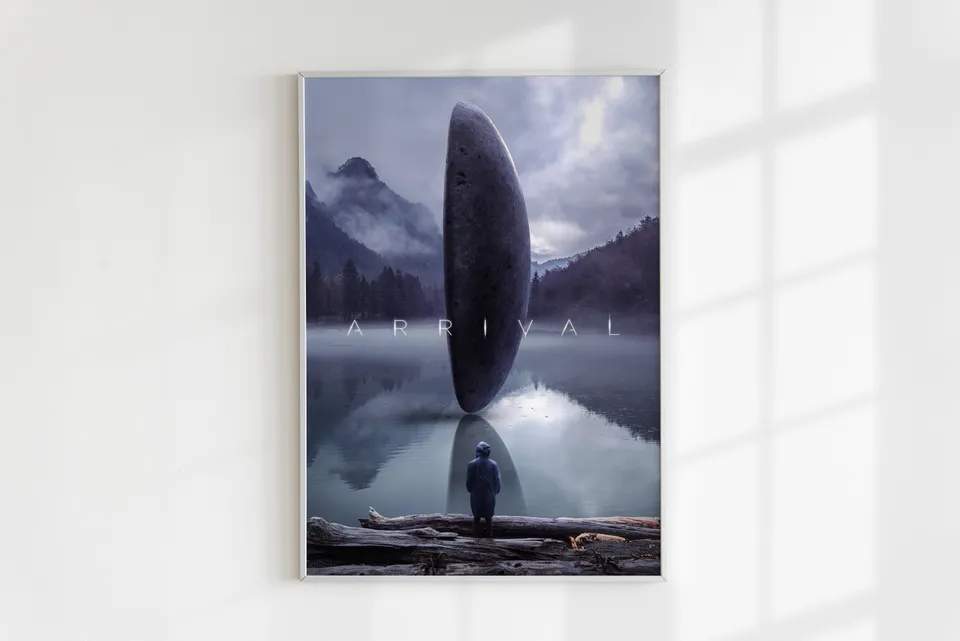
Released in 2016 and directed by the visionary Denis Villeneuve, Arrival is the pinnacle of what alien movies should be, exploring the genre through a variety of lenses ranging from linguistics to deep human emotion.
The world is thrown into chaos when twelve massive, shell-like spacecraft descend on various locations across the globe. Unlike most alien invasion films, these “Heptapods”, seven-limbed beings, don’t attack; they simply wait. Louise, a linguistics professor, quickly realizes that the Heptapods’ spoken language is undecipherable, so she pivots to their written language that is made up of complex, circular symbols called logograms. As she deciphers these intricate blots, she discovers that their language is non-linear and begins to perceive time as the aliens do (time as a fluid and whole). It turns out the “flashbacks” she had been experiencing were actually flash-forwards. Knowing the heartbreak that lies ahead, Louise chooses to embrace the journey anyway, for the sake of the joy in between.
Science-fiction has a long tradition of imagining alien arrival as spectacle — explosions, warfare, flashing lights, and cities reduced to rubble – as in 1953’s War of the Worlds. Arrival quietly refuses all of that. Much of the film’s action is psychological, intellecual and theoretical, with experts and professionals studying data and swapping theories on how to determine the purpose of the newly arrived life forms. The film is rooted in the Sapir-Whorf hypothesis, the linguistic theory that the language you speak shapes the way you perceive reality. As Louise learns to read and write in the Heptapods’ non-linear script, her perception of time begins to shift — as does the audience’s. Viewers are invited to contemplate complex ideas such as the nature of time, fate, and the weight of our choices. This is what makes Arrival the kind of science-fiction film we hadn’t seen in years. It is big and spectacular without being cheap or flashy. It is slow and deliberate without being boring. Villeneuve withholds and reveals information with surgical precision, using each beat to carefully craft the film’s tone and tension.
Another element the film perfects is its use of setting and color to build atmosphere. Through muted, milky visuals and natural lighting, the film creates a mood that feels heavy and contemplative. The alien vessels are not gleaming or technological. They are dark, silent, monolithic shapes that hover over the landscape like unanswered questions. The score is both haunting and beautiful, generating emotion atmospherically rather than announcing it. That said, the film’s consistently muted, cerebral tone may not always be to one’s personal taste. As someone who enjoys high-tension action sequences, I occasionally found myself wishing for a more climactic moment. However, I recognize that any such addition would have undermined the very qualities that make the movie special.
The film’s final act re-contextualizes everything that came before it through a genuine, earned shift in our understanding of time and the world around us. Everything ultimately boils down to themes of existential anxiety and the inevitability of loss. The central question Arrival poses is one of the most quietly devastating a film could ask: if you knew exactly what the future held — every joy, every loss, every ending — would you still choose it?